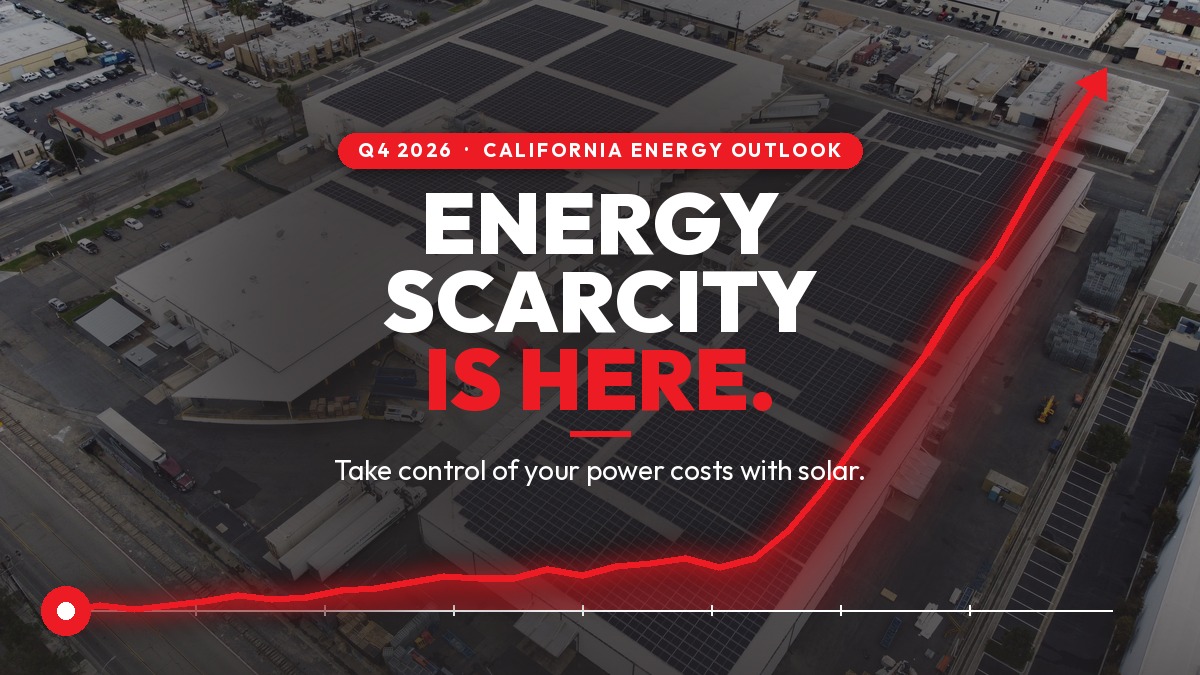
If you run a facility in California, you’ve watched three headlines stack up this fall: a war in the Middle East choking global energy supply, AI data centers racing to lock up every megawatt they can find, and a statewide push to electrify fleets, equipment and buildings. Any one of them would strain the grid. Together, they are turning electricity into something most businesses haven’t had to think about in decades: a scarce resource.
You can’t control any of those forces. You can control how much of your power you buy from the utility. Here is the plain English breakdown of what’s driving the squeeze, what it means for your operating costs, and why the next few months matter more than most.
Three Forces Squeezing the Grid at Once
1. A war-driven global energy shock
Since the conflict with Iran began in late February, tanker traffic through the Strait of Hormuz has been restricted for most of the year. Crude shipments are finally getting back toward prewar levels, but exports of refined fuels like diesel are still running at only about half of normal – and the strait is getting more dangerous, not less, with a new wave of tanker attacks since late September. That’s why diesel – the fuel that moves nearly everything your business buys and sells – set new all-time highs above $6 a gallon in September, up nearly 80% since January. It has eased for two straight weeks and still sits near $6.20. And in Europe, where the gas squeeze has hit hardest, the European Commission just asked member countries to cut gas and electricity use heading into winter.
To be clear, California’s electricity rates aren’t set by the price of oil, and U.S. natural gas has held up well thanks to strong domestic production. But the war is a hard reminder of how quickly energy costs you don’t control show up in your freight, your supplies and your budget.
2. AI data centers are competing for the same power you use
Data centers use 10 to 50 times more energy per square foot than a typical office building, and they are chasing grid capacity everywhere. Moody’s estimates the U.S. data center boom will need $110 billion of new power plants by 2030 – adding an estimated $25 to $30 billion a year to the nation’s electricity costs.
Even the biggest players are hitting the wall. In late September, Oracle sent a force majeure notice on its 2.45-gigawatt Project Jupiter campus in New Mexico after the gas pipeline meant to power it slipped to 2027. Oracle says the campus is still on schedule, but the notice protects it if the power doesn’t arrive in time. When a company with Oracle’s resources can’t count on power arriving on schedule, the grid’s limits are no longer theoretical.
California is feeling it too. The state’s grid operator approved more than $2 billion in South Bay transmission upgrades largely to serve data center and electrification load – and under federal rules, the cost of transmission upgrades is spread across all ratepayers in the grid operator’s territory. Governor Newsom signed a package of data center bills on September 21 meant to shift more of those costs onto data centers themselves, but the thresholds and rate structures haven’t been written yet.
3. Electrification is adding load on top of it all
Electric trucks and forklifts, heat pumps and new production lines are all plugging into the same system. The EIA expects U.S. electricity generation to set a record in 2026 and again in 2027, with commercial and industrial demand leading the growth.
The takeaway: More demand means more poles, wires, substations and transmission lines – and in California, those costs land on your bill as delivery charges. That’s a big part of why commercial rates have climbed as fast as they have: SCE commercial customers saw rates rise an average of roughly 9.2% per year from 2018 to January 2026, according to data compiled by the California Solar & Storage Association (CALSSA).
Sacramento is starting to push back. On September 30, Governor Newsom signed a slate of affordability bills, including SB 905, which directs regulators to consider letting utilities earn less on certain spending like wildfire costs and undergrounding power lines, and SB 1098, which reins in the special accounts utilities use to pass costs through between rate cases. These are real steps, but they hand the work to the CPUC, and even supporters say it’s the follow-through under the next governor that will decide whether customers see lower bills. Some SCE business customers may even notice a small dip on October bills as costs SCE has finished collecting roll off – but the same update added new charges for the 2018 Woolsey Fire. Rate updates move costs around. None of them slow the demand driving the buildout, and nothing in the forces above points toward the long-term trend reversing.
Why Solar Is the Standalone Answer
When electricity gets scarce and expensive, the most valuable kilowatt-hour is the one you never have to buy. Commercial solar turns your roof, parking lot or unused land into a power plant that sits behind your meter – so every kWh it produces is one you don’t pay the utility’s rising delivery charges on.
- It turns a variable cost into a fixed one. Your utility bill is a moving target that resets every time a rate case closes. A solar system is a known cost, with panels backed by 25-year product warranties.
- It hedges against the forces you can’t control. Wars, data center demand and grid upgrades all push utility rates up. None of them change what your array produces.
- It pairs with storage to attack demand charges. Add a battery system and your facility can cover its own load during the 4–9 p.m. peak, when power costs the most. A new state law, SB 913, also directs regulators to better measure and reward batteries that help the grid at peak – potential upside on top of your own savings.
- It’s an asset, not an expense. Accelerated depreciation (MACRS) and the federal Investment Tax Credit make solar one of the strongest capital projects a facility can take on.
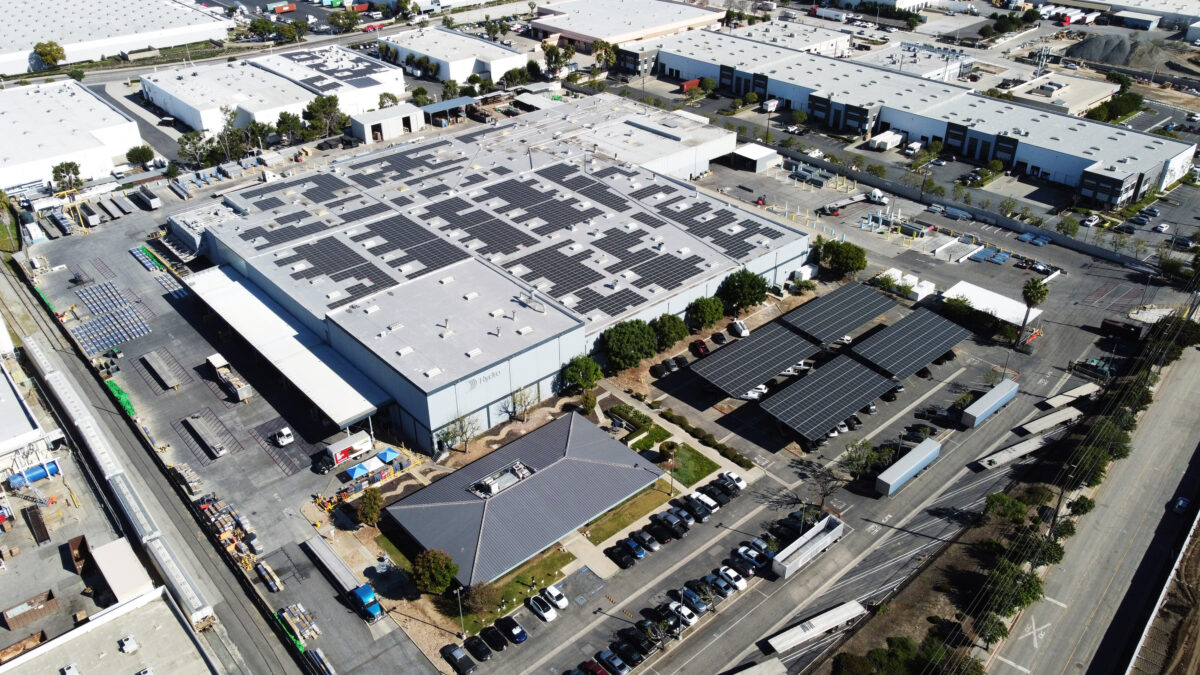
This isn’t theory. At Hydro Extrusions in the City of Industry, Revel built a 983 kW rooftop-and-carport system that offsets roughly 30% of a plant running heavy loads around the clock. Two refrigerated warehouses at Orange County Cold Storage now carry nearly 2 MW of solar, built while the buildings stayed fully operational. Both projects posted payback periods under four years. Paybacks vary by site and by the incentives in place when a project is built, which is why we model every proposal from your actual interval data – not rules of thumb.
The Clock: Why Q4 2026 Is the Signing Window
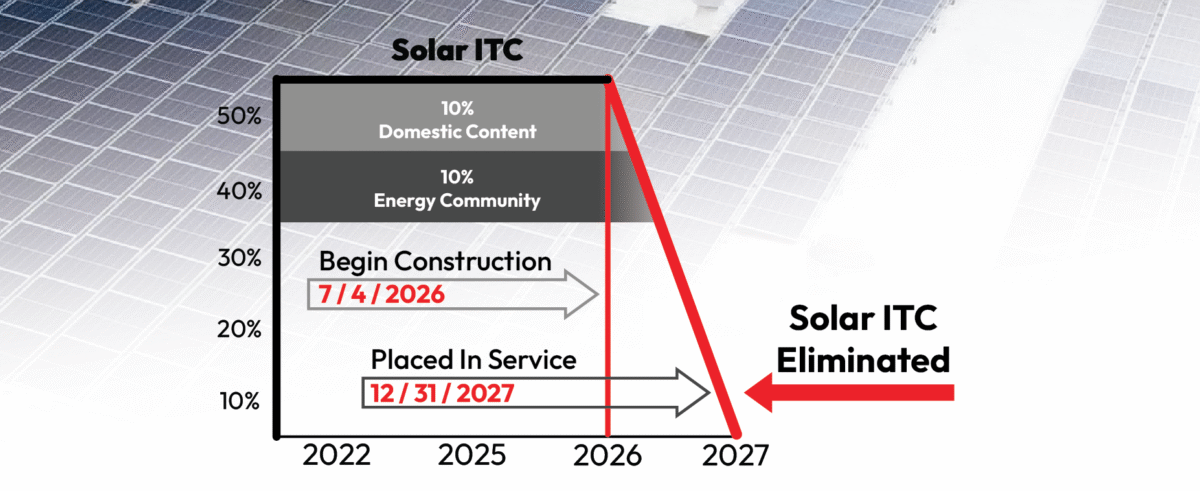
There’s one more constraint, and it’s on the calendar. To earn the 30% federal Investment Tax Credit, a commercial solar project must be placed in service – built, inspected and interconnected – by December 31, 2027. The safe harbor that let projects “start now, finish later” closed on July 4, 2026.
That sounds like plenty of runway. It isn’t. A commercial project typically takes 6 to 12 months or more from signature to energization: engineering, permitting with the local building department, and the utility interconnection queue. State data shows PG&E and SCE have missed some required interconnection timelines as much as 73% of the time – and every business chasing the same deadline is about to join the same queue.
Meanwhile, equipment is getting more expensive, not less: imported solar module prices are up more than 40% since the Section 232 tariffs.
In plain English: projects signed before 2026 ends have the buffer to absorb a slow utility. Projects signed in mid-2027 are betting their tax credit on it.
When the Grid Says “Not Yet”: Revel PowerBridge
Scarcity doesn’t only show up in your rates. For a growing number of Southern California businesses, it shows up as a flat “no” – a service upgrade request denied or queued for years because the local circuit is out of capacity.
If you’re adding equipment, shifts or EV chargers and the utility can’t deliver the power, Revel PowerBridge delivers it now: a temporary, behind-the-meter battery system, actively managed by Revel, that gives your site usable capacity in months instead of years. Because it never exports to the grid, it avoids the utility’s multi-year interconnection study path. When your permanent solution – a utility upgrade or a Revel solar-plus-storage system – is in place, we remove it.
One partner, both horizons: bridge the gap now, and build the permanent fix in parallel.
The Bottom Line
You can’t negotiate with a war, a data center boom or a utility rate case. You can decide how much of your energy you buy from the grid – and lock in that decision while the federal incentive is still on the table.
What to Do Next
- Get the hard numbers: Request a Free Energy & Financial Analysis. Send us 12 months of utility bills or interval data, and we’ll model your system size, savings and the timeline to hit the 2027 deadline.
- Short on power? Ask us to check your circuit. In about five minutes, we can show you which SCE circuit serves your building and how much spare capacity SCE projects for it – from public data, at no cost.
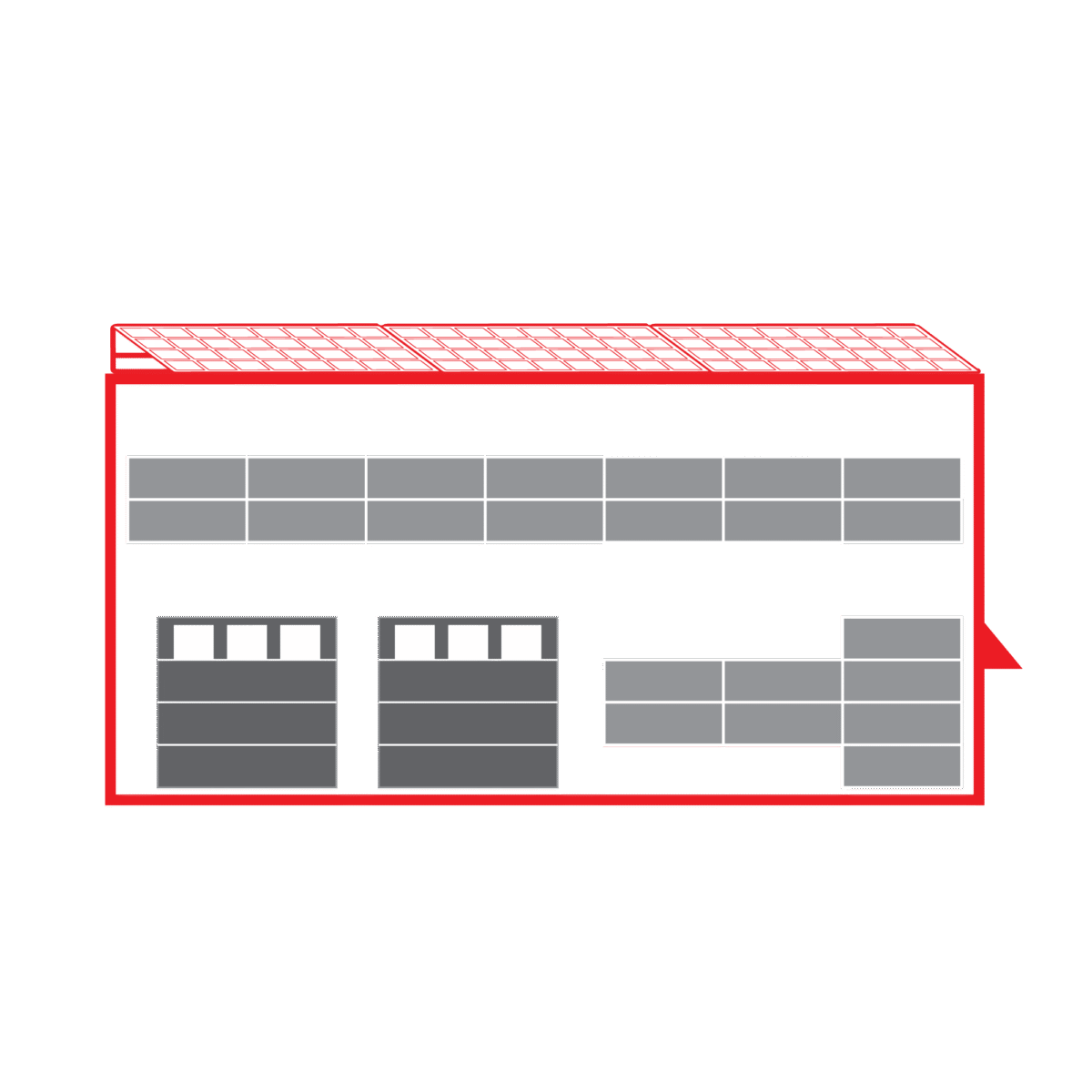
ROOFTOP SOLAR
Commercial grade rooftop solar is ideal for: manufacturing, warehousing, logistics, industrial, retail, hospitality buildings and more with over 10,000 sq. ft. rooftops.
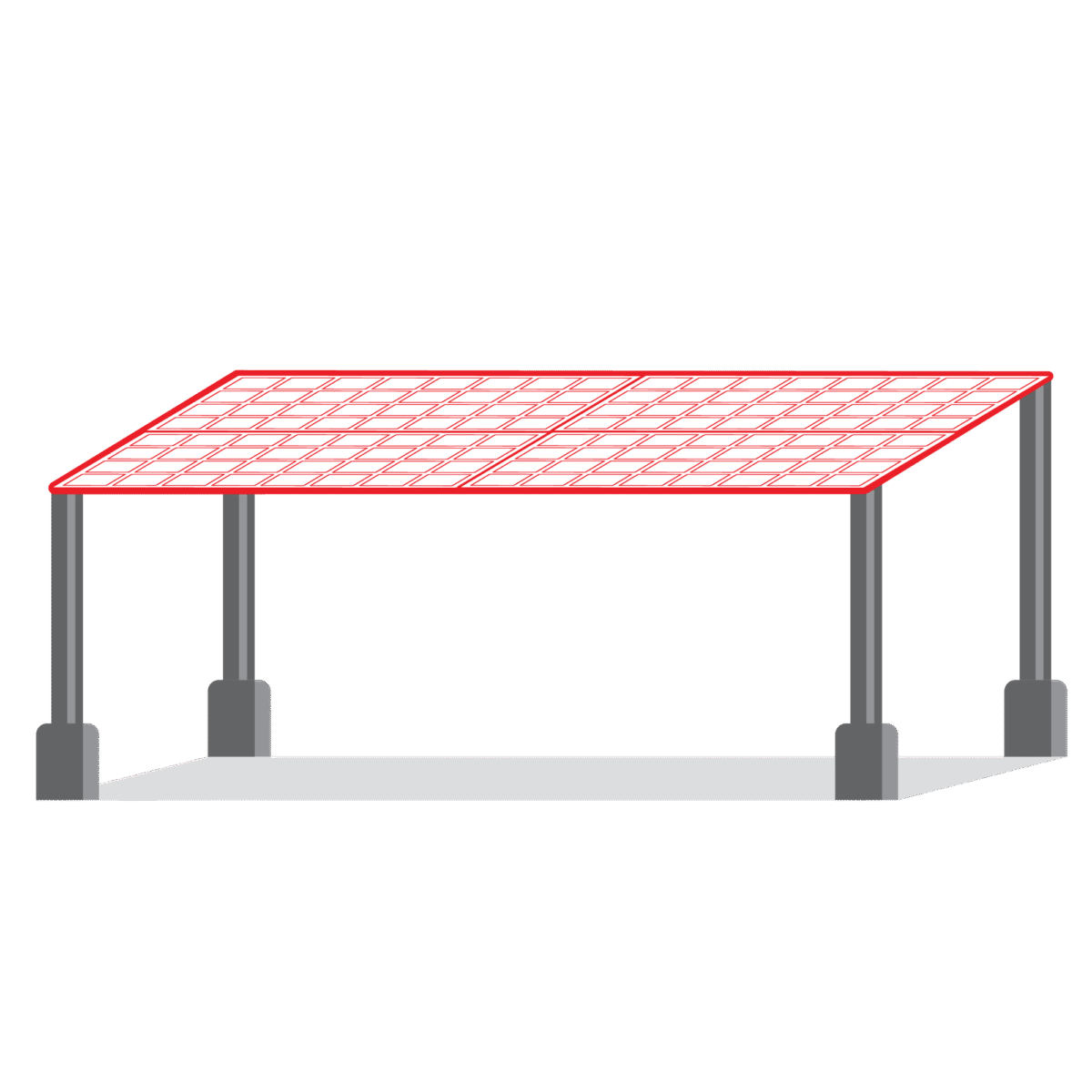
CARPORT SOLAR
Free standing carport solar generates added solar power for properties with limited rooftop space. Added benefits include shading and protection for employees vehicles.
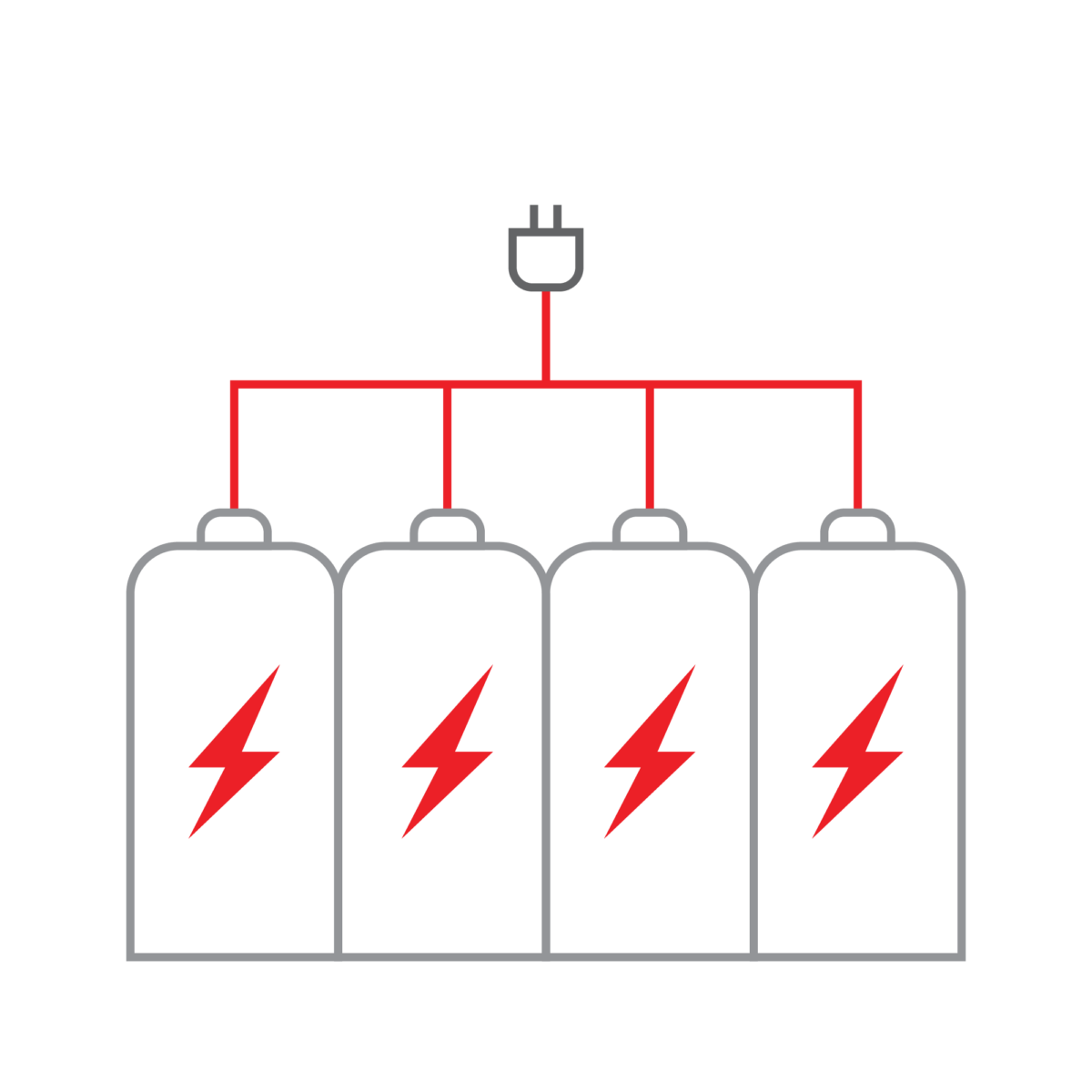
ENERGY STORAGE
Crucial for reducing peak demand charges. Automated to supply electricity when your panels won’t. Energy storage is ideal for businesses that incur significant peak charges.
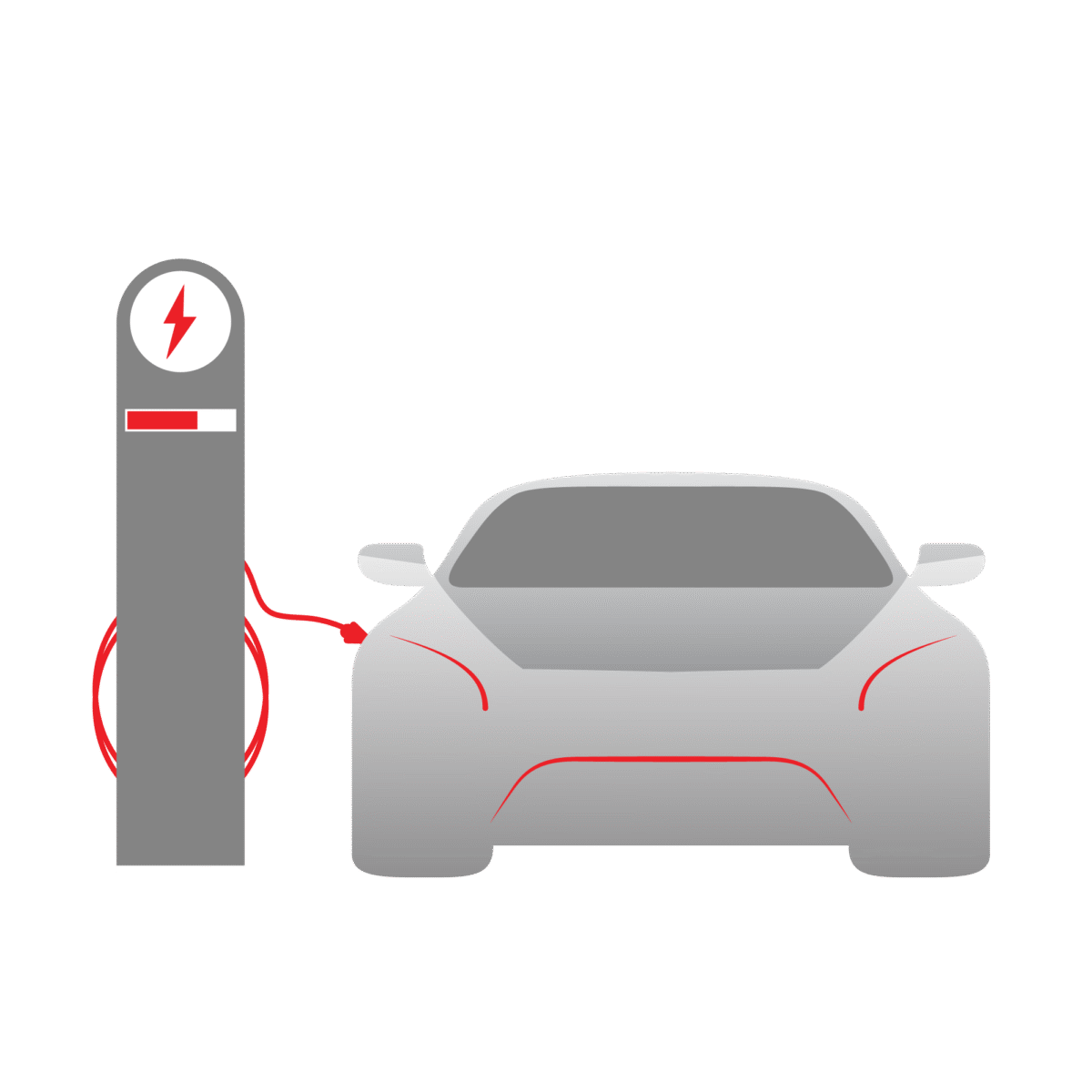
EV CHARGING STATIONS
As the popularity of EVs increase, so does the demand for on-site EV charging stations. This sustainable amenity has become a parking lot fixture for employers.
CREATING CAPITAL THROUGH SUSTAINABILITY, WE OFFER:
PROFESSIONAL GUIDANCE
CUSTOM TAILORED PLANNING
ENGINEERING, PROCUREMENT, CONSTRUCTION & INSTALLATION
CSLB #1106092
Client Testimonial: Kelemen Company
Corporate Business Park in Irvine, CA has created significant electricity cost savings through commercial solar installed across the 5-building business park.
Client Testimonial: Tice Gardner & Fujimoto LLP
See how this CPA firm saved on electricity and gained valuable tax credits through commercial solar that they used to keep cash in the businesses.